Shell
In a defensive capacity, your structure may become a Shell.
Stage 01 · The foundation
Think of Fundamentals as the foundation upon which all of your tools and tactics are built.
In the same way that a home requires a strong foundation to remain durable, stable, and long-lasting, an effective Self-Protection system must also be built on a solid foundation.
For Self-Protection to remain proactive, effective, and adaptable, the fundamentals behind it must continue to work even when circumstances change.
At Hawaii Krav Maga, that foundation is built around what we call the 4 P’s:

Why We Do What We Do
Principles are the inherent truths that govern our system. They explain the why behind what we do.
When you understand why you are using a specific tool or tactic, you gain the ability to adapt when circumstances change or when that tool stops working as expected.
Technique without principle can collapse when variables change, and in a real-world confrontation, change is inevitable.
Principles give you the ability to adapt rather than simply memorize.
Structure
Posture, or structure, is the physical framework we use to maintain the ability to become defensive or offensive depending on the situation.
Good posture is a balance of both stability and mobility.
Proper structure should allow you to access defensive and offensive tools efficiently.
In a defensive capacity, your structure may become a Shell.
In an offensive capacity, that same structure may become a Rhino.
The value of good structure is that it allows you to remain capable of becoming proactive or reactive without having to completely reset your body position.
Line of Sight and Field of View
When it comes to threat recognition, what you are looking at and how you are looking at it are critically important.
The ability to notice a concealed weapon, a second attacker approaching from an angle, or even a subtle change in a threat’s posture can make a significant difference in your ability to respond.
You cannot protect yourself from something you are completely unaware of.
Picture is broken down into two components:
Line of Sight is what you are directly looking at.
In a Self-Protection situation, this would normally be the immediate or primary threat.
Your Line of Sight establishes your primary visual focus.
Field of View is how you are looking at the entire situation.
Think of it as the bigger picture.
If Line of Sight represents your primary focus, Field of View represents everything happening around that focus.
This means using your peripheral vision and environmental awareness to identify additional threats, movement, obstacles, escape routes, or changes in the situation while still maintaining awareness of the immediate threat.
P.O.A. vs. P.O.N.
Positioning is about managing distance, angles, and your relationship to a threat.
This includes:
We use a clock system to help explain positioning.
Imagine that you are standing in the center of a clock. The threat represents 12:00, and the other clock positions represent the different angles around you.
This is the same basic concept used when someone says:
“Watch your six.”
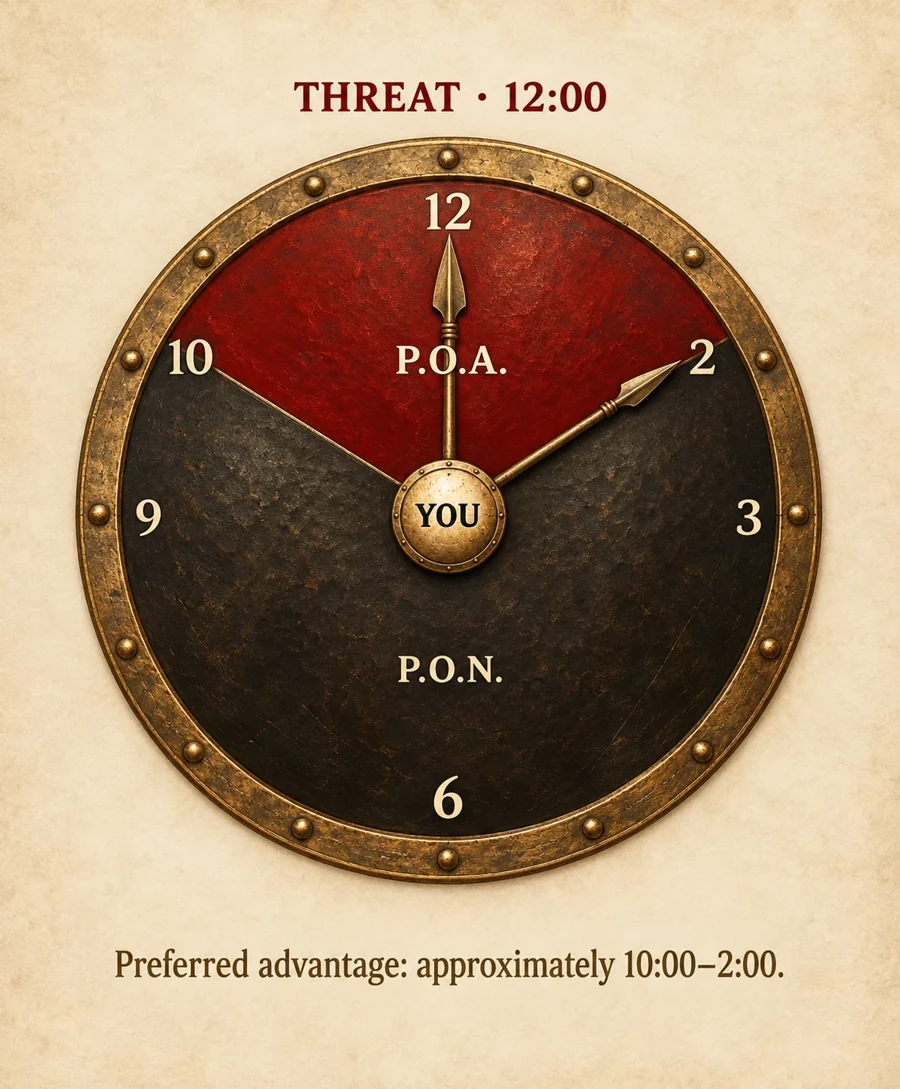
We divide positioning into two primary categories:
With the threat positioned at 12:00, a Position of Advantage generally exists between approximately 10:00 and 2:00.
A Position of Advantage is a position that gives you the best opportunity to control distance, use your tools effectively, maintain awareness, and respond to the threat.
Whenever possible, we want to recognize, create, or maintain a Position of Advantage.
A Position of Necessity is any position outside of the preferred Position of Advantage.
With the threat positioned at 12:00, these would generally include the remaining clock positions outside the 10:00-to-2:00 range.
These are positions you may find yourself in because of circumstance rather than choice.
Examples may include:
A Position of Necessity is not necessarily where you want to be. It is where you may find yourself.
The goal is to recognize that position, adapt to it, and work toward improving your position whenever the opportunity becomes available.